Case study
Remote BLE Audio Trigger
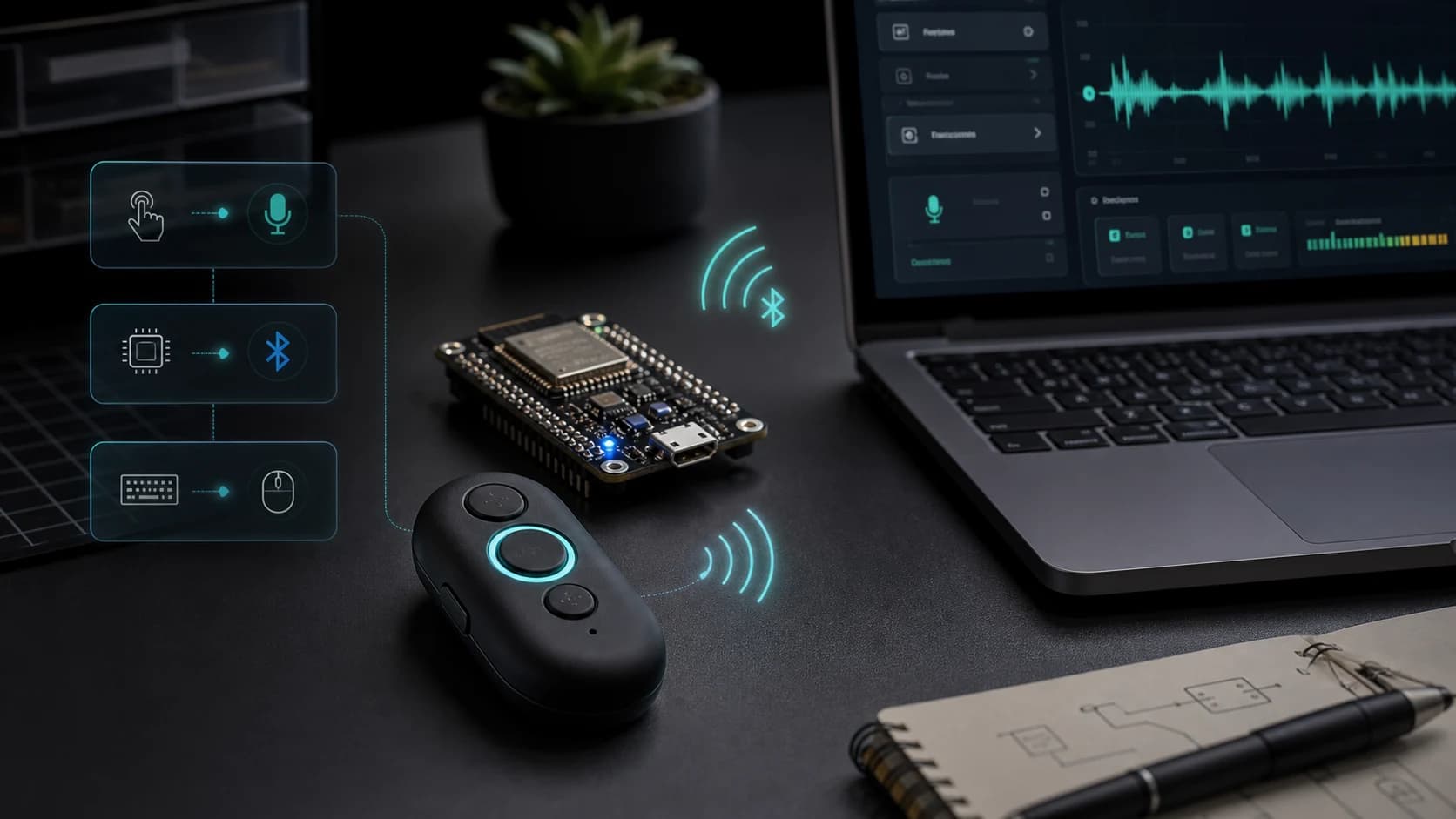
ESP32 remote that fires desktop shortcuts and routes onboard-mic audio over BLE.
Summary
Built a remote trigger that pairs over BLE to fire desktop shortcuts and prototype mic-audio handoff to the system — useful for push-to-talk workflows.
Problem
Push-to-talk and shortcut-firing on a laptop are clumsy when your hands are full or you're a few feet away. Off-the-shelf BLE remotes do one thing badly. I wanted a small ESP32 device that pairs cleanly, fires desktop shortcuts I actually use, and can route audio from its onboard mic to the host system for push-to-talk workflows.
Approach
I started with the hardware action set, not the firmware. Three or four buttons, each mapped to a desktop shortcut, plus one held-button mode for mic capture. The firmware advertises as a BLE HID for the shortcut side and a separate profile for the audio handoff. Pairing is sticky so the device reconnects without prompting after sleep. The audio prototype was the harder half. Capturing onboard-mic samples and streaming them over BLE in a way the host can consume meant working around bandwidth and latency constraints, plus making the buffer logic survive intermittent disconnects without garbled audio. Built on ESP32 with PlatformIO in C++. The point was reliability of a few hardware actions, not a Swiss Army knife.
Architecture
Result
The remote pairs cleanly, fires shortcuts without missed presses, and routes mic audio for push-to-talk end-to-end. Designed around a few rock-solid hardware actions instead of a long feature list. Built, used daily, and shared as a working IoT artifact.
Highlights
- BLE pairing + reliable shortcut firing
- Onboard-mic audio prototyped end-to-end
- Designed around a few rock-solid hardware actions
Have something similar?